Rick MorrisEditor · Writer · Broadcaster

02 · The work

Sport.
On the page.
On air.

Rugby photojournalism. Football editing.
Sports commentary and interviews.

A lifelong interest in sport took Rick from the stands at Twickenham to magazine features, coaching books and the radio studio.

Selected sports publicationsPrint
Original publication covers from Rick’s sports portfolio.

Writing · Editing · Photojournalism

A feel for the game.
An eye for the story.

Rugby features and tournament publications sit alongside Rick’s work editing a football coaching book.

Rugby Football Union

Rick’s role · Photojournalism

England Rugby

Rick worked as a photojournalist for the RFU’s England Rugby magazine, developing feature ideas and carrying them through to the finished work.

His interest in rugby took him to Twickenham and other Six Nations grounds. As Rick recalled on his original website, one trip to Dublin even led to an engagement.

Rugby · Magazine

Rugby World Cup 2011:
Official Review

This official tournament review is one of Rick’s sports magazine credits. His work in print also includes England Rugby and World Cricket.

In a related piece, Rick considered what smaller nations’ performances at the 2011 World Cup reveal about success in rugby.

Read the archive summary

Football · Book editing

The Winning Formula

Soccer skills and tactics

Rick edited The Winning Formula: Soccer Skills and Tactics, written by the Football Association’s Director of Coaching.

Explore his publishing work
Archive reading · 2011 Rugby World CupDoes population size matter?Read the summary

A condensed reading of the piece in Rick’s original sports portfolio. The tournament results and population comparisons refer to 2011.

At the 2011 Rugby World Cup, countries with very different population sizes competed on the same stage. New Zealand won the tournament, while Wales stood out for its play. Both showed what a strong rugby culture could achieve.

The Pacific Island teams offered further evidence. Tonga and Samoa each won twice and came close to reaching the quarter-finals. Tonga’s victory over France was a particularly striking result. Earlier performances by Samoa and Fiji also challenged the idea that a bigger country must produce a stronger team.

The piece argues that population size alone does not determine success. Enthusiasm for the game, hard work and the ability to build a team matter more. Rugby still gives smaller nations the chance to compete with—and beat—much larger opponents.

Read the full piece on Rick’s original website, opens in a new tab

From the radio archive

The game.
The people. The conversation.

Rick’s sports programmes ranged from athletics and tennis to pétanque. Hear three original archive recordings: rugby match commentary, an interview with Jason Leonard and a cricket report.

01 / Rugby0:31

London Welsh

Match commentary

A passage of live rugby commentary following a catch, a passing move and a penalty near the halfway line.

Open audio file: London Welsh, opens in a new tab
Read transcript: London Welsh

Machine-assisted transcript with punctuation added. [Unclear] marks uncertain words; refer to the recording for exact wording.

A high one, Dougie Flockhart's under that, he's caught it and he's running. He's been caught, flips it out to the fly half, who gets it out to Seb Jewell in the centre and out to the winger, number 11, Charlie Amesbury. Wearing a scrum cap, interestingly, for a wing three quarter, they don't normally. Must have sensitive ears. And the referee's blown there, it appears to be a penalty to Esher on around the halfway line, just inside the Welsh half.

[Unclear] kick if he were to go for it.

02 / Rugby2:36

Jason Leonard

Interview

A conversation about amateur and professional rugby, camaraderie and the work behind playing at the highest level.

Open audio file: Jason Leonard interview, opens in a new tab
Read transcript: Jason Leonard

Machine-assisted transcript with punctuation added. [Unclear] marks uncertain words; refer to the recording for exact wording.

Interviewer: I'm standing here at the Twickenham Stoop in the bar. Alongside me is a wonderful man, Jason Leonard.

He used to be a member of Quins for many years and a former England player with 100 and some odd caps, Jason.

Jason Leonard: 114.

Interviewer: How many years did you play international rugby?

Jason Leonard: All in all, I played 14 years international rugby, so quite fortunate. I think it was seven years amateur, seven years professional, so I got to see the best of both worlds.

Interviewer: I think you did, and you were one of those lucky ones. An era when the players had a proper job, they were policemen or they were, you I think, were a joiner.

There were school teachers, army officers, solicitors doing a proper job during the week and then turning out and playing of a Saturday and training of course during the week as well. Must have been tough.

Jason Leonard: It was hard, but I think now because you experienced that and how the game has changed, I mean the landscape is completely different now of the professional game.

That actually brings some enjoyment with it as well because, as you said, you'd come to a game or you'd come to training and one guy would be a doctor and one guy would be a solicitor and one guy would be a builder and one guy would be a policeman.

And the banter and the crack, the camaraderie that brought about was absolutely fantastic and it was a very special time and you actually got great enjoyment out of a game that was your hobby. You actually played for nothing.

And in the professional era, you got asked that your hobby would become your job. Well, you couldn't get a better job in the world. So I've been very lucky and very fortunate.

Interviewer: And very skilled, I would have to say. I mean, you worked extremely hard to be where you are.

Jason Leonard: I think if you want to succeed in anything, you've got to work hard. You talk to kids today, young young people today when you're talking about rugby in particular.

You see someone like Jonny Wilkinson that they can all see and they idolise as a top class player.

The reason why he's a top class world class player is because it's not what you see on an 80 minutes on a field.

It's the hours and hours and hours of hard work that you don't see that are either in gyms or on the training ground,

practicing kicking at goal and everyone seems to think you just turn up on a Saturday afternoon at 3 o'clock and that's what you do.

There's a lot more that goes into the job than that.

Interviewer: You must have spent hours in the gym.

Jason Leonard: Hours in the gym in the professional era, most probably in the amateur era, hours in the pub.

Interviewer: The last time you and I met, and you probably don't remember, was in the sun in Richmond.

You were with Jeff Probyn, I think, that evening. And the landlord, we had a bit of a lock-in.

Jason Leonard: It's always one of the best pubs in the area. It's still my local after all these years.
03 / Cricket1:14

Test Match Cricket

Sports coverage

A studio recap of England’s final Test against South Africa, covering the teams’ first-innings performances.

Open audio file: Test Match Cricket, opens in a new tab
Read transcript: Test Match Cricket

Machine-assisted transcript with punctuation added. [Unclear] marks uncertain words; refer to the recording for exact wording.

Our thoughts turned to South Africa. Those of you who have been following the test cricket there will have had a difficult three days if you're an England supporter. England went into the final game of the test series, one nil up. So all we had to do was draw this match or win it and they would win the series. Andrew Strauss won the toss on the opening day and seems to have made the mistake of electing to bat. And England was skittled out for a very meager score, 180 all told. Strauss [Unclear] out for a duck and it just went from bad to worse

After that, very few saving graces. Collingwood and Bell, bless them. They chipped in in the middle order with 47 for Collingwood, 35 for Bell. Graeme Swann, who's a tremendous off-spin bowler, chipped in with 27 towards the end. But it wasn't enough. 180 all out. Never was going to be enough. And Graeme Smith survived. Confident appeal for caught behind. Early on in his innings and went on to score 105. Amla batting at number three, scored 75, de Villiers, 58. And Mark Boucher was heading for a century.

Graeme Swann got him with the first ball of a new over and Boucher was out for 95. Nevertheless, South Africa notched up a score of 423 for seven, declared, giving them a comfortable lead of 243 on the first innings.

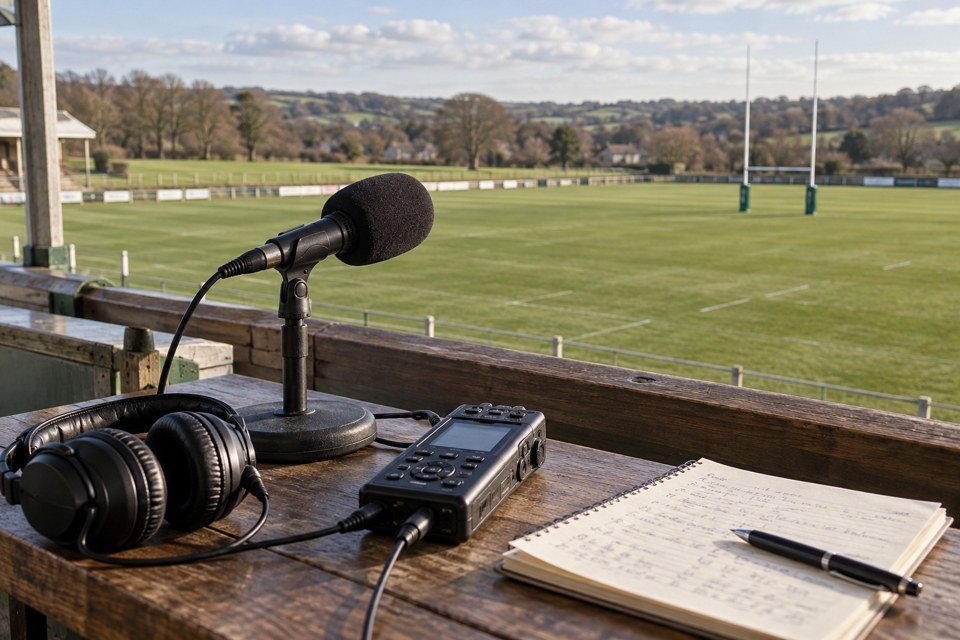
Illustrative rugby commentary desk overlooking a pitch, with microphone, headphones and match notes
Rugby · Commentary · Match notesIllustrative scene; not a photograph of Rick’s work.

Behind the microphone

Following the action.
Finding the story.

The recordings above are preserved from Rick’s original website. Each includes a transcript and a direct audio link.

“Rick has proved a master at filling our sports-related programmes with varied, interesting and relevant content.”

Robin CorryPress & Communications Director, Brooklands Radio Ltd

Selected career credits

Across sport.
Across different media.

A selection of the organisations, publishers and publications listed in Rick’s sports portfolio.

Organisations & publishers

  • Rugby Football Union
  • William Collins
  • TRMG Publications
  • Haymarket Magazines

Publications

  • England Rugby
  • World Cricket
  • World Cup Football: Preview

Broadcasting

  • Brooklands Radio

Sports enquiries

A question
about the work?

For questions about a publication, a recording or material in Rick’s sports portfolio.

info@rickmorris.euWrite to Rick